August 26, 2026
Why is there no Disease Information Statement?
An analysis of the deficiencies of the MMR Vaccine Information Statement
This week we learned of two tragic measles deaths in Pennsylvania in unvaccinated individuals, the first in the US this year but probably not the last. There are many angles to this situation. There is the malign contribution of Andrew Wakefield and his ilk. There is the corrosion of official vaccine messaging at the highest levels of HHS. There’s the distrust engendered by COVID-era errors in judgment by the public health establishment.
But there’s also something interesting going on in the extremely mundane department of…paperwork. Specifically the Vaccine Information Statement legally mandated to be handed out alongside the MMR vaccine.1 Take a look at it. What do you notice?
One thing I notice is a conspicuous absence of numbers. Here’s how measles is described:
causes fever, cough, runny nose, and red, watery eyes, commonly followed by a rash that covers the whole body. It can lead to seizures (often associated with fever), ear infections, diarrhea, and pneumonia. Rarely, measles can cause brain damage or death.
All true! But no numbers. “Rarely,” it can cause brain damage or death. How frequently is “rarely”? Unstated. How frequently do people suffer illness severe enough to require hospitalization? ¯\_(ツ)_/¯.
Another thing I notice is an asymmetry of emphasis. Looking at the rest of the document, I see a checklist of reasons to postpone or skip the shot, a section on vaccine reaction, a section on what to do if a serious reaction happens, with instructions to call 911. Then the federal reporting system for adverse events. And a federal program that compensates vaccine injuries, with a filing deadline.
Overall, more than half of the document, 56% by word count, is devoted to the possibility that the vaccine will hurt you. The three diseases combined get 15%. The vaccine’s benefits get two sentences, 4% of the document.
Here’s the rundown:
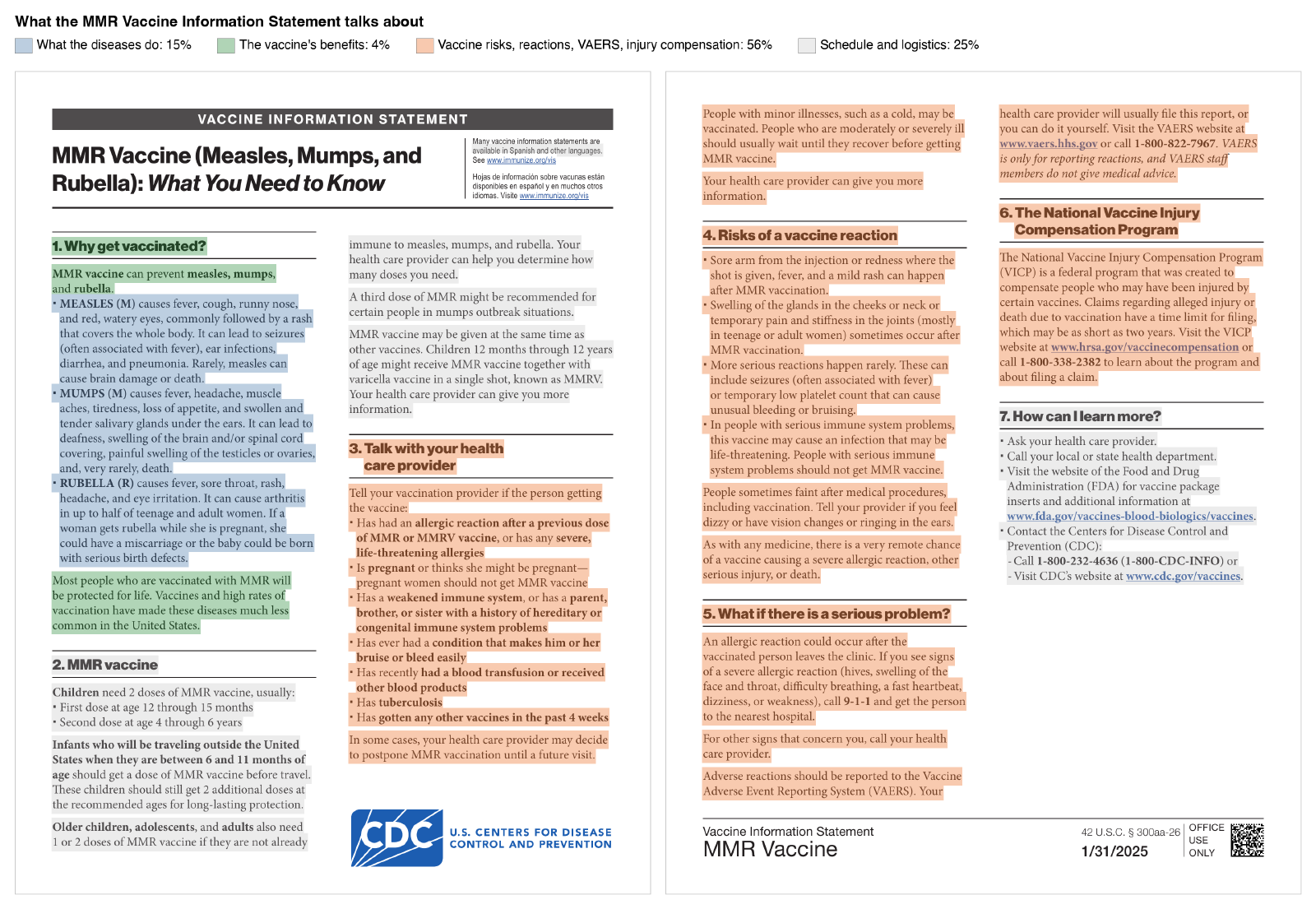
And the absence of numbers really does leave a distinct misimpression.
Measles death: “Rarely, measles can cause brain damage or death.”
Vaccine death: “a very remote chance of a vaccine causing a severe allergic reaction, other serious injury, or death.”
“Rarely” sounds pretty similar to “a very remote chance.” In reality measles hospitalizes 1 in 5 unvaccinated people who catch it and kills roughly 1 in 1,000. MMR has never been documented to have killed a healthy person. Not rarely. Never.2
I wanted to include a chart comparing these two risks, but it can’t really be drawn. On one side, we have 1 in 1,000. On the other, we have 1 in…an undefined denominator. “Rarely” vs. “very remote” doesn’t really convey this clearly.
Why is the document like this? The VIS exists in the first place because of the National Childhood Vaccine Injury Act of 1986, which rescued the vaccine supply from a liability crisis by creating an injury compensation program. As part of the bargain, the law mandated that this information be provided, and it listed ten things the materials had to contain. First on the list: “the frequency, severity, and potential long-term effects of the disease to be prevented by the vaccine.”
But that requirement no longer exists. In 1993, a housekeeping amendment titled “Simplification of Vaccine Information Materials,” responding to complaints that the original 12-page pamphlets were unwieldy, struck all ten items and replaced them with four: the vaccine’s benefits, the vaccine’s risks, the injury-compensation program, and whatever else the Secretary of HHS wants. Disease severity was no longer a required element.
As far as I can tell, this was happenstance. I don’t think there was any conspiracy to hide the ball. And I have no objection to slimming the thing down. It just seems to me that something important was lost in the transition from 12 page pamphlet to 1 page handout.
Maybe the law should be re-amended to once again require a full account of just how bad the diseases in question are. Or maybe future leaders of HHS and CDC can augment the VISs in this way voluntarily.
In the meantime, there’s nothing stopping pediatricians from providing this information. Even if most people don’t read this stuff, it matters on the margins that the official communication on these topics is passively misleading about the risks.
Calypta Health offers tools to help with this problem, including a guide for MMR specifically. Should we build Disease Information Statements, too, as supplements to the numberless VISs?
This edition of the MMR VIS is dated January 31, 2025, and the document has read essentially this way for thirty years. These deficiencies aren’t the work of the current HHS and CDC. ↩︎
The handful of vaccine-strain deaths on record were in severely immunocompromised patients, which is exactly why the vaccine is contraindicated for them. ↩︎